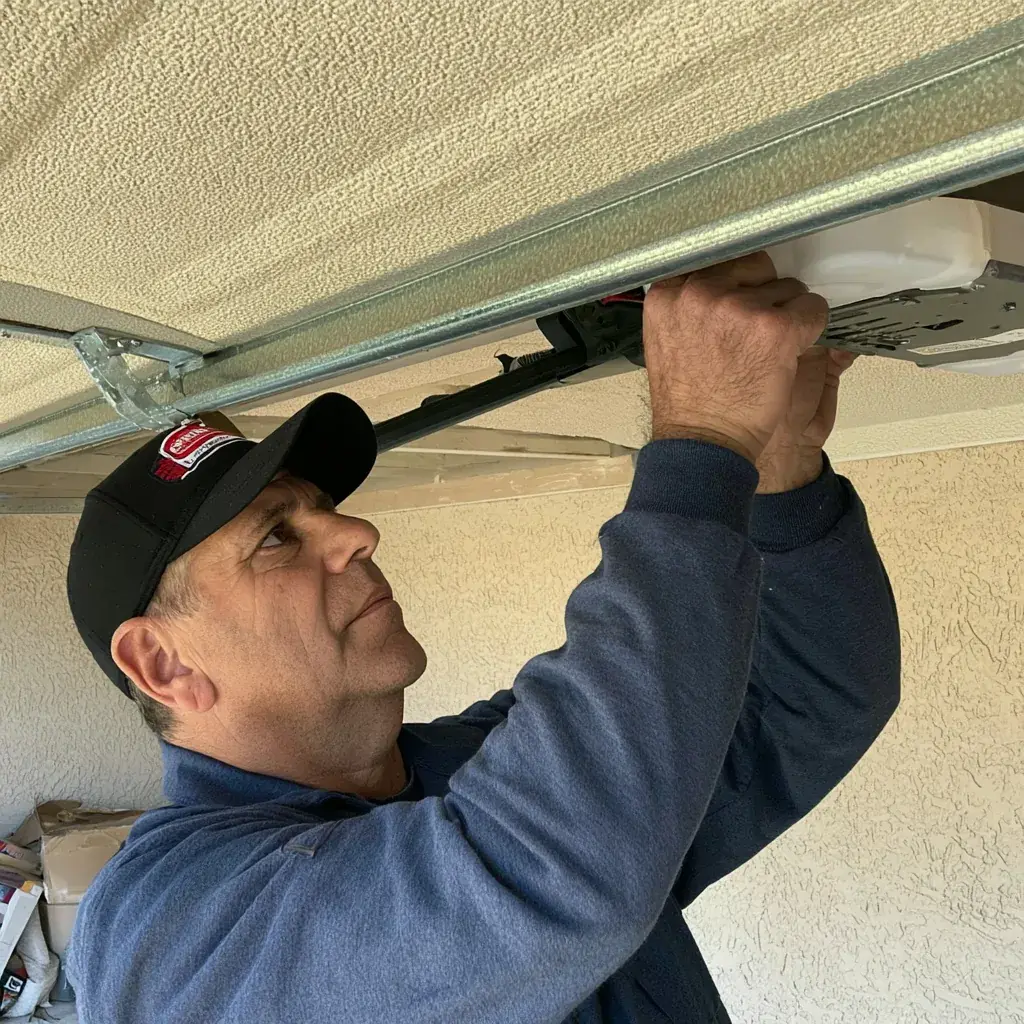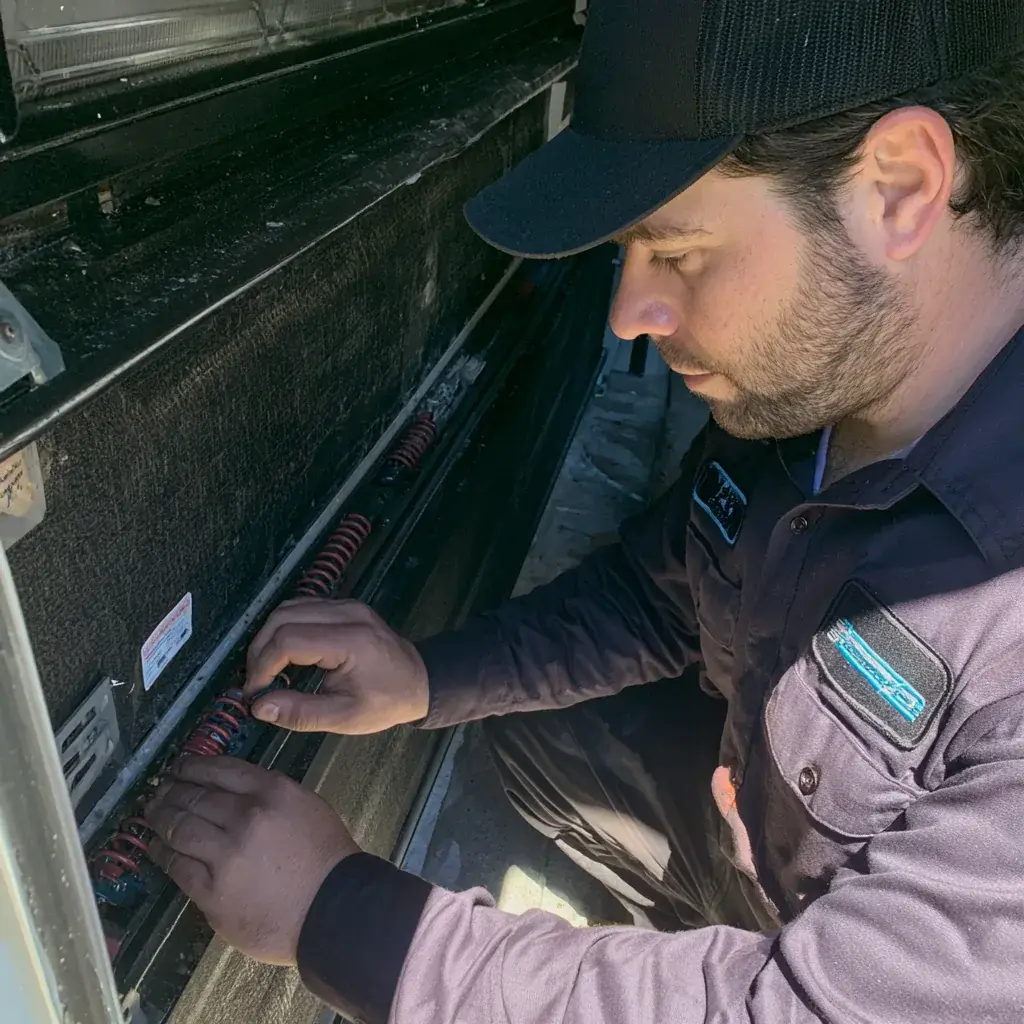
A door that binds in the exact same place, cycle after cycle, is not acting randomly. It is hitting a fixed obstruction or a fixed misalignment. That repetition is the useful part. A door that catches somewhere different every time suggests a loose part bouncing around, but one that snags at the same inch of travel points to something that does not move: a bent track section, a shifted bracket, or a spot where the opening itself is no longer square.
The Same Spot, Every Cycle
A door that snags at one exact point in its travel, cycle after cycle, is pointing at a fixed obstruction rather than a general wear problem. Something along the track is narrower or off-line at that height, so rollers catch it every single pass. Richardson garages built decades ago often show this as tracks pull slightly inward partway up, a spot where a hinge has spread, or a section where the rail no longer lines up with the one above it.
Track Bends Leave A Mark
Look at the vertical track first, since a dent or bow there almost always lines up with where the door catches. A bump from a car bumper, a stored ladder, or a box shoved against the wall near the opening can leave a small kink that is easy to miss standing back but obvious up close. Run a hand along the track slowly, feeling for a spot where the metal is not flat. In Richardson garages built directly on a slab, this is often the simplest explanation.
A Bent Roller Or Hinge
If the track itself looks straight, the next place to check is the roller and hinge riding through the bind point. A roller with a flat spot or a bent hinge plate will hit the same resistance every time it reaches that section, because the part causing the drag is attached to the door and travels with it. Cycle the door slowly by hand, watching where each roller sits when the binding happens, and note which one lines up with the trouble spot.
Panel Damage That Repeats
A warped or dented panel can also cause a repeating bind, especially on older sectional doors around Richardson Heights or Greenwood Hills where panels have had decades to take small hits. A section that has bowed even slightly changes shape as it curves around the track radius, and that change shows up at the same point in the curve every time. Check the panel edges near the bind point for a dent, a bow, or a hinge screw that has worked loose from the metal.
Frame Shift From Clay Soil
Dallas County soil holds a lot of clay, and that clay tightens or loosens with rainfall the way a sponge does. As it moves, the concrete slab under a Richardson garage can tilt or lift unevenly along one edge. That shift pushes the track frame out of its original position at one height, and the door starts hanging up at that exact point every time it runs, even though the opener and springs are working fine.
Where To Stop And Call
If tightening the track bolts and squaring the rail does not stop the same-spot bind, or if the frame itself looks bowed at that height, stop adjusting it further. Forcing a misaligned track can pull it loose from the jamb or crack a panel. That is the point to bring in the licensed pros we connect you with, since realigning a track tied to a shifted frame calls for tools and leverage most homeowners do not keep on hand.
Testing Without Forcing It
Before calling anyone, disconnect the opener and move the door by hand, slowly, to feel exactly where the resistance starts and stops. Forcing the opener through a bind point again and again puts extra strain on the motor and gears and can turn a track problem into a motor problem. If the door will not move past the spot smoothly by hand either, stop there. That resistance is mechanical, not electrical, and pushing the opener harder will not clear it.
Noise At The Bind Point
Pay attention to sound as well as motion. A grinding or scraping noise right at the bind point usually means metal on metal, which points to a roller or track problem rather than a spring issue. A softer thud or hesitation without noise can point instead to a spring losing tension unevenly, which changes how much lift the door gets at different points in its travel. Either way, the exact location matters more than how loud it is.
Two-Car Doors Show It Sooner
Wider two-car doors common in newer sections of Richardson, including streets near Canyon Creek and Prairie Creek, carry more weight across the same track length, so a small bend or misalignment shows up as a bind sooner than it would on a narrower single door. The extra span also means a frame shift from clay soil movement has more distance to affect, which is one reason a wide door binding at one spot deserves attention before it gets worse.
When Weather Makes It Worse
A bind that was mild in fall can turn sharper after a hard freeze, since cold stiffens lubricant and metal contracts slightly. Richardson winters bring routine occasional hard freezes, and a door already fighting a bent track or a shifted frame has less room to move once the metal tightens up. If a bind point that used to be minor suddenly stops the door outright on a cold morning, that is the frame or track problem finally running out of slack.
What Happens If It's Ignored
Left alone, a repeating bind does not stay small. The opener keeps pushing against the same resistance, which wears the gears and strains the springs unevenly, and the track damage causing the bind tends to worsen rather than heal. A homeowner near J.J. Pearce or Berkner Park dealing with a bind that has lasted more than a couple of weeks is better off having the licensed pros we connect you with look at the track and frame before the opener takes the next hit.
Dealing with this in your home?
Slab foundations near Cottonwood Heights and Prairie Creek shift as clay expands after rain, then contracts in triple-digit heat. That movement racks the frame around the garage opening, so tracks bind and rollers wear unevenly. The posts below cover what pulls a door out of true, what a fix costs, and when a panel job beats a full replacement.