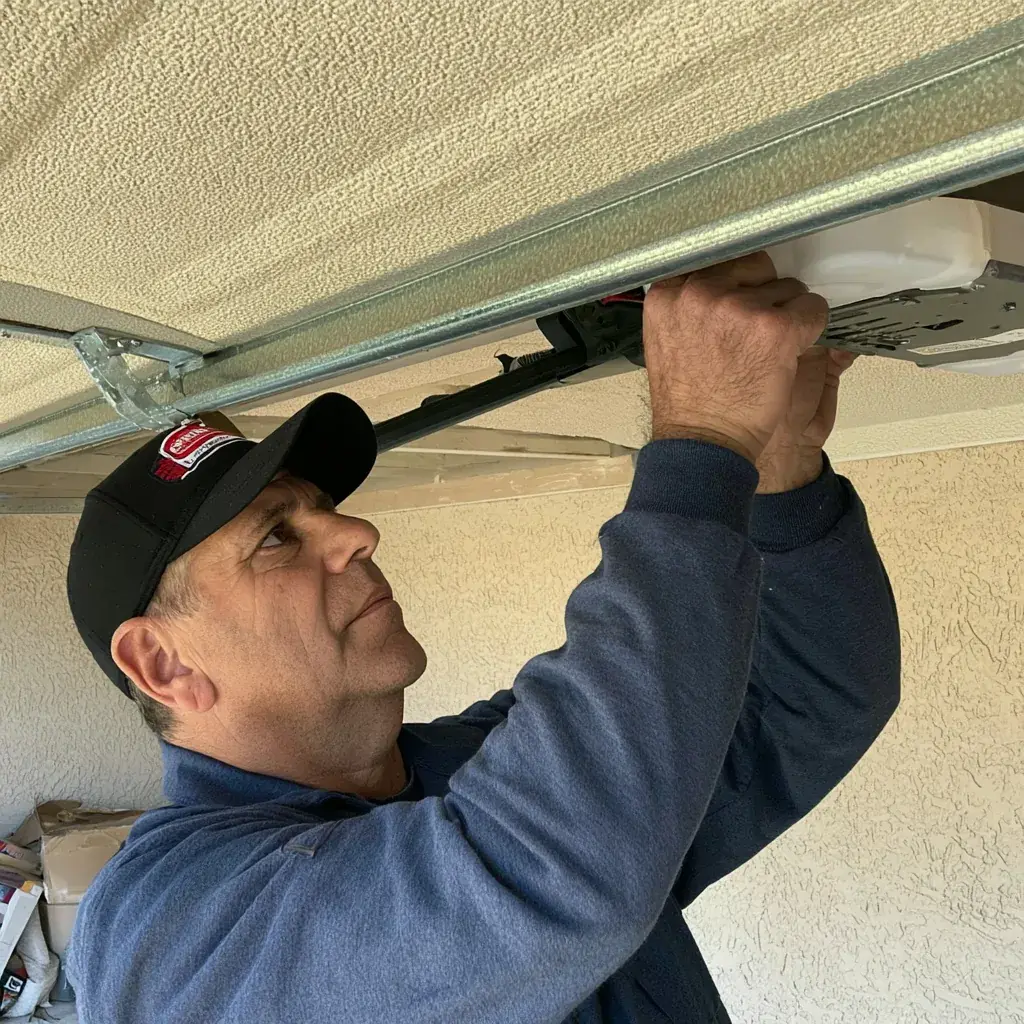
A door that jumps its track usually announces itself with a bang, then stops moving or hangs at an angle. In Richardson, this often follows years of slab foundation shift on the expansive clay soil common across the city, which slowly pulls a track out of square. A stuck cable, a bent roller, or a hit from a car backing out too fast can also do it. The fix depends on which part gave way first, so the first job is figuring out what actually happened before touching anything.
Stop Before You Touch It
Stop using the door the moment a panel looks crooked or a cable hangs loose. Do not pull the emergency release cord and try to force the door up or down by hand, since a door off its track can drop without warning even with the opener disconnected. Keep the car parked outside, keep kids and pets away from the opening, and resist the urge to push the panel back into the track yourself. That last part causes more injuries than the original problem ever does.
Reading What You See
A door off its track has usually jumped a roller out of the channel, not snapped in half. Look at where metal meets metal along both sides of the opening. One roller hanging loose outside the track means a bent section or a loose bracket, common as a Richardson slab settles on Blackland clay over the years. Both tracks pulled away from the frame is a different problem, tied to the whole panel binding under strain. Note which side moved before touching anything, since that detail changes the repair.
When a Spring Is the Cause
Springs under tension are the most common reason a door comes off track violently rather than settling gently out of place. A torsion spring that snaps sends the door slamming or twisting, which can rip a roller straight out of its track. Extension springs that lose tension unevenly do something similar. Either way, the spring itself is not something to loosen, wind, or remove without the right bars and clamps, since the stored force can cause a serious injury.
Bent Tracks and Loose Brackets
Once a track has bent even a little, closing the door again can pull it further out of alignment instead of fixing anything. Richardson homeowners near Cottonwood Creek or Prairie Creek sometimes notice this after a hard storm rocks the door in its opening, but it happens on ordinary streets too, especially where clay soil has nudged the garage frame a few degrees off level over time. The safest move is to stop touching the opener and check the rollers and hinges by hand first.
Parking Pads and Daily Wear
Off-street parking pads on many Richardson lots put daily wear on a garage door that homes without one avoid, since the door opens and closes more often with a car parked there rather than in a driveway further back. More cycles mean more chances for a worn roller or a loosening bracket to finally fail. This is not a defect specific to any one neighborhood, just simple math: doors that move more, more often, wear out their weakest part sooner.
Cold Mornings and Weak Springs
Winter mornings with lows in the mid-30s can stiffen an aging spring or thicken old lubricant right before a track failure shows up, since a spring that was already weak has less give when it is cold. This does not cause the derailment by itself, but it often speeds up a problem that was already building. A pre-winter check on cables, rollers, and spring tension catches this kind of wear before a hard freeze turns it into a stuck or dropped door.
Storm Damage and Sudden Failure
Hail and straight-line wind from a spring storm can knock a door off track directly, by denting a panel hard enough to warp the frame, or indirectly, by cutting power mid-cycle and leaving the door half open with cables still under load. Richardson has seen documented tornado damage as recently as 2019, when a storm tracked through North Dallas and into the city, so a door that comes off track right after severe weather is worth treating as storm damage, not routine wear.
Creek-Adjacent Lots and Moisture
A door that comes off track near a low point in the yard or close to a creek corridor like Cottonwood Creek or Floyd Branch can be a sign that water got under the bottom seal and softened the track's wood mounting strip over time. This is not common across all of Richardson, but a garage sitting lower than the street around it is worth a look at the mounting hardware, not just the track itself.
How the Repair Gets Priced
The licensed pros we connect you with can usually tell within a few minutes of arriving whether the fix is a bracket, a track section, a roller, or a spring, since each one leaves a different pattern of wear on the door and frame. A track that pulled away cleanly at one bracket is a faster job than a door that dropped because two rollers left the rail on opposite corners, and pricing follows that difference rather than a flat number.
Permits for Electrical Repairs
A garage housing an opener with an electrical connection can fall under Richardson's general permit rules for work affecting a structure's electrical or mechanical systems, though this has not been confirmed as a specific requirement for track repair alone. Homeowners with questions about a particular repair can call Richardson's Building Inspection Department directly rather than guess, since the answer depends on what exactly is being replaced.
When It Keeps Happening Again
Most track failures do not need a full door replacement, just the bent or detached section, a bracket, and sometimes a roller or cable. But a door that has come off track more than once in a year, especially without a storm or impact to explain it, usually points to a frame that has shifted with the slab underneath it. That is a different conversation than a one-time repair, and it is worth raising with whoever comes to look at it.
Dealing with this in your home?
Slab foundations near Cottonwood Heights and Prairie Creek shift as clay expands after rain, then contracts in triple-digit heat. That movement racks the frame around the garage opening, so tracks bind and rollers wear unevenly. The posts below cover what pulls a door out of true, what a fix costs, and when a panel job beats a full replacement.