A grinding noise from a garage door in Richardson usually means metal parts are no longer moving the way they should. Homeowners near Canyon Creek or Heights Park notice it first thing in the morning, when the door is cold and every rough spot in the track or every worn roller announces itself. The sound is not random. It points to a specific part that has started fighting the door instead of helping it move, and ignoring it lets that part get worse.
Worn Rollers Are Common
Worn rollers are one of the most common sources of grinding, especially on doors that have cycled through several North Texas summers. Nylon rollers can crack or flatten from heat, while steel rollers lose their bearings over years of use. Either way, a roller that no longer spins freely drags against the track instead of rolling through it. That drag produces a rough, grinding sound each time the door opens or closes, and it tends to get louder as the roller degrades further.
When The Track Shifts
Grinding often comes from the rollers themselves. Steel rollers without sealed bearings wear down over years of North Texas heat and cold, and once the bearing surface pits, every trip through the track produces a scraping, grinding sound rather than a smooth roll. Nylon rollers fail differently, cracking or flattening on one side. Either way, the noise gets louder as the damaged roller nears the bend at the top of the track, right where the door changes direction.
Listen For The Opener Gear
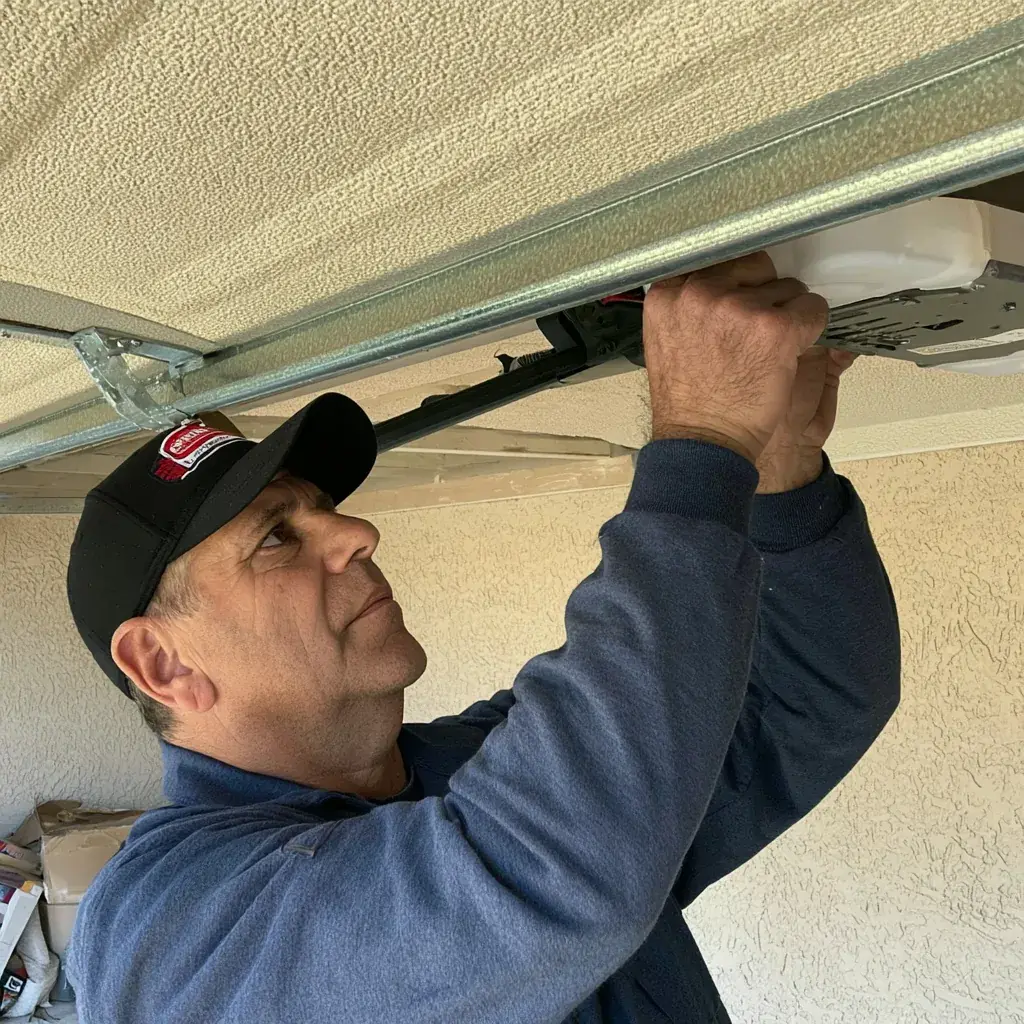
The opener itself can also be the source, particularly if the noise seems to come from overhead near the motor rather than along the tracks. A worn drive gear inside a chain or belt-drive opener grinds as it engages, especially once the gear teeth start to strip down. This is a different failure than a spring or track issue, and it usually means the opener unit needs attention rather than the door panels or hardware.
Dry Hinges Between Panels
Dry or corroded hinges between door panels can grind as the door bends around the curve of the track. Every panel joint relies on a hinge pivoting smoothly, and metal that has lost its lubrication resists that motion. Instead of moving quietly, the joint catches and releases in a jerky motion that produces a grinding or scraping sound. This is one of the easier causes to check without removing anything, since the hinges are visible along the face of the door.
Lubrication Wears Off Everywhere
Lack of lubrication across the whole system compounds nearly every other cause on this list. Rollers, hinges, and the torsion spring itself all depend on a thin layer of lubricant to move without resistance. Once that lubricant dries out or washes away, metal parts that used to glide start to catch. A door that has gone years without any maintenance in a Richardson garage, especially through hot summers and freezing winter mornings, is a strong candidate for this kind of noise.
Bearing Plates Wear Down
A grinding sound tied to the opener motor itself, not the door's travel, points to the gear inside the unit. Older chain-drive and belt-drive openers use a plastic drive gear that wears down over years of triple-digit summers and routine use, and a stripped gear grinds loudly without moving the door much at all. If the door barely inches along or stalls while the motor keeps running, stop using the opener switch and pull the emergency release before the gear fails completely.
Check For Track Debris
Debris in the track is a simpler explanation worth ruling out before assuming a mechanical part has failed. Dirt, dried leaves, or small pieces of broken weatherstripping can lodge inside the track and force a roller to grind past them with every cycle. A visual check along both tracks, from the floor up to the curve near the ceiling, can reveal whether something is simply stuck where it does not belong.
Cold Mornings Stiffen Grease
Grinding that only happens during the first cold mornings of the season often traces back to stiffened lubricant rather than a broken part. Richardson winters bring routine hard freezes, and grease that flows fine in a triple-digit summer can thicken enough in the mid-30s to resist movement. The door works, but every moving part fights the cold grease slightly, and that resistance shows up as noise until the mechanism warms up or gets relubricated.
What Not To Spray On It
Do not spray general household oil or water-displacing lubricant onto a torsion spring or the opener's drive gear hoping to quiet the noise. The wrong lubricant can attract more dirt or break down quickly under heat, making the grinding worse within weeks. Do not keep running the door through repeated open-close cycles to see if the noise clears on its own, since that only adds more wear to whatever part is already struggling.
It Depends On Your Morning
How much a grinding door matters depends on the household's schedule. A family in Richardson Heights leaving early for a commute down Central Expressway does not have time to diagnose a noise before work. A household near Prairie Creek trying to get kids to J.J. Pearce on a normal morning faces the same pressure. The noise itself will not strand anyone the way a door stuck open does, but ignoring it lets a small mechanical problem turn into a bigger one.
Finding The Actual Part
A grinding noise almost never fixes itself, and running the door again just wears the damaged part further. Rollers, hinges, and worn gears eventually fail outright, sometimes while the door is halfway open. Homeowners in Richardson Heights or near Cottonwood Heights who catch the sound early usually face a simple roller or hinge swap; waiting until the noise turns into a bang usually means a bent track or a broken opener gear instead.
Dealing with this in your home?
Slab foundations near Cottonwood Heights and Prairie Creek shift as clay expands after rain, then contracts in triple-digit heat. That movement racks the frame around the garage opening, so tracks bind and rollers wear unevenly. The posts below cover what pulls a door out of true, what a fix costs, and when a panel job beats a full replacement.