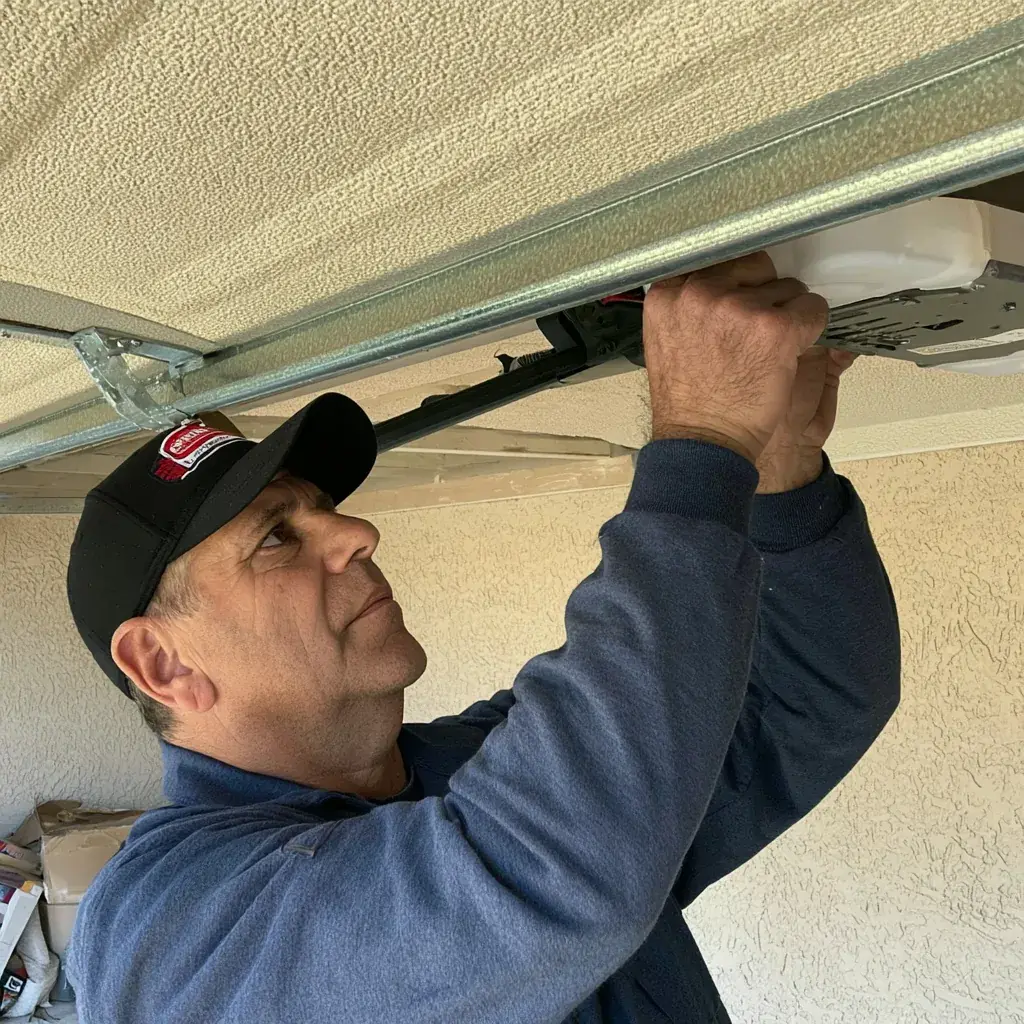
A Richardson garage door that catches partway down and climbs back up is a common call from Canyon Creek to Berkner Park. The door starts closing, stops a few inches or a couple feet from the slab, and reverses to full open without finishing the cycle. It can happen once and never again, or every single time you press the button. Either way, the opener is doing something on purpose: it thinks the path is not clear, and it will not finish closing until you find out why it thinks that.
Federal Sensor Rule Applies Here
Federal law since 1993 requires garage door openers to reverse rather than clamp down on anything blocking their path, and Richardson installers meet that rule with two small sensor units facing each other near the floor. Dust, a stray leaf, or a shift in one bracket can break that invisible beam. Once broken, the opener refuses to finish closing, since it cannot confirm the doorway is clear. This is usually the first thing worth checking before anything else.
Two Lights Means Aligned
Check each unit before touching any settings. Both glowing steady usually means the beam between them is unbroken and pointed correctly at its partner. One blinking or dark tells you where the trouble sits. Sun angle matters too; a low winter sun coming through an open door in a Richardson driveway can wash out the beam enough to fool it, so shade the lens with your hand and watch whether the light steadies.
Then Check the Travel Limit
Next comes the down-travel figure stored in the opener's control board, the number telling the motor exactly how far to drop before it counts the door closed. Set that figure too shallow and the door stops inches above the slab, reverses, and never reaches the ground. This is a dial or button sequence on the motor unit itself, and it drifts on its own more often than most Richardson homeowners expect.
A Setting That Slips Over Time
That figure rarely stays put for years without reason. A remote button mashed while the door was already partway through its cycle can shift it. So can a breaker tripping mid-cycle during a Richardson thunderstorm, since the motor sometimes reboots into a slightly different memory state. Homes near Central Expressway with frequent power blips see this more, and it is worth a look before assuming a bigger part has failed.
Look for Something in the Track
With the sensors and the stored figure both ruled out, check the track itself for anything wedged inside it. Storage bins pushed too close to the wall, a garden hose looped over the rail, or a bent section from a car bumping the frame can all stop the door short. Roll the door by hand with the opener disconnected and feel for where it catches; that spot usually points straight at the obstruction.
Clay Soil and a Shifting Frame
Richardson sits on clay soil that swells after rain and pulls back tight during a triple-digit summer stretch, and that constant movement can twist a slab foundation just enough to throw the door frame off square. When the frame shifts, the track no longer lines up the way it did when installed. The door reaches a certain point, meets resistance, and the opener stops rather than force it through a bind it was not built to push past.
The Force Setting Plays a Role Too
There is also a force figure stored next to the travel setting, and it decides how hard the motor pushes before deciding something is blocking it. Set it too gently and a door dragging slightly on a warped weatherstrip, or catching on a frame nudged out of square by the clay under a Richardson slab, gets treated the same as a real obstruction, so the opener reverses well short of the ground every time.
When a Spring Is the Real Cause
If the sensors read clear and the travel setting looks correct, check the door's springs next. A worn spring stops holding up its share of the door, so the opener senses more resistance than normal and stops the cycle. Homes in older Richardson subdivisions near Duck Creek, with doors original to the house, run into this more than newer construction. This is not something to test with your hands, since a spring under tension can snap without warning.
The Torsion Spring Itself
Many Richardson garages, including houses through Canyon Creek and Northrich, lift the door with a torsion spring set on a bar above the header rather than the stretched side springs older designs used. That bar stores enormous tension, and a spring nearing the end of its life can snap without warning while under load. This is not a repair to attempt personally; it belongs to trained hands only.
Openers Built Without Eyes
Some older sections of Richardson Heights and similar pre-1990s pockets still carry openers built before the federal photo-eye mandate took effect, and those units have no sensor pair to check at all. If your motor closes the door fully with no pause and no blinking light anywhere near the floor, the unit likely predates that rule, and a straightforward closing failure there points more toward the travel or force settings than any sensor problem.
When None of the Four Fit
When the sensors, travel setting, track alignment, and spring all check out fine and the door still refuses to close, something less visible is likely at play. The licensed pros we connect you with can run the opener's circuit board, wiring, and motor gear through a proper diagnostic to find what four visual checks cannot catch on their own.
Dealing with this in your home?
Slab foundations near Cottonwood Heights and Prairie Creek shift as clay expands after rain, then contracts in triple-digit heat. That movement racks the frame around the garage opening, so tracks bind and rollers wear unevenly. The posts below cover what pulls a door out of true, what a fix costs, and when a panel job beats a full replacement.