Extension Springs and Cables in Richardson
How stretch springs and safety cables carry older Richardson garage doors.
Extension springs lift a garage door by stretching along each side track instead of twisting on an overhead shaft. Safety cables must run through them, since a snapped spring can otherwise fire loose hardware across the garage.
How the Stretch Spring Works
An extension spring sits above each horizontal track and lifts a Richardson garage door by stretching, not twisting. As the door travels down, the spring pulls longer against the track; as the door rises, the spring contracts back toward the rear wall. That stretching action, repeated on both sides at once, is what separates this system from a torsion shaft. Older sections of Richardson, including homes near Richardson Heights and Heights Park, still carry this original hardware from before torsion shafts became the standard mount.
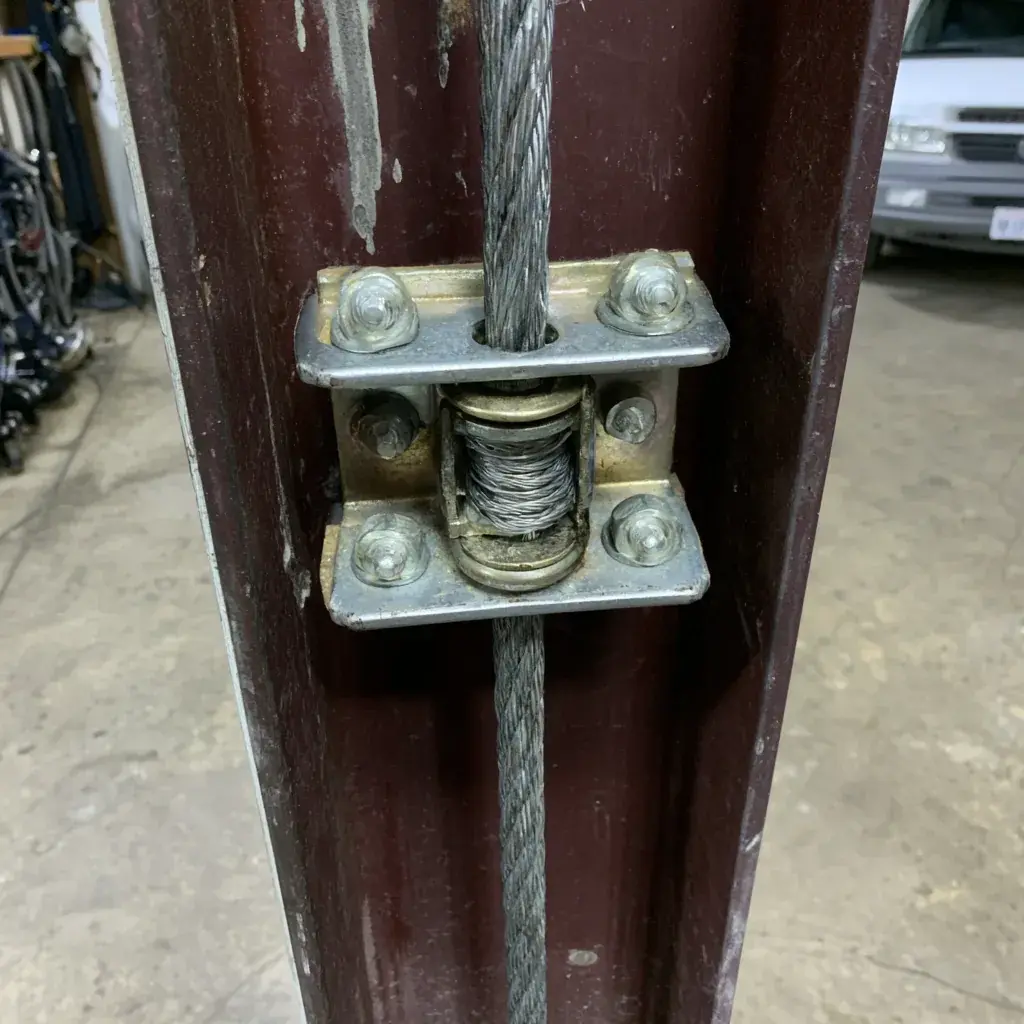
The pulley sits bolted near the back of the horizontal track, and the spring rides forward of it under tension the door's weight creates through the cable. In garages around Heights Park and Northrich, where openings are narrow and the track run is short, that pulley bracket takes years of friction from the cable riding across it every time the door travels.
A stretched, exposed coil running the length of the track, visible the moment the door is open, is the clearest sign of an extension system in a Richardson garage. There is no shaft above the opening, no set of springs mounted crosswise over the header. Instead the hardware rides low and horizontal, tucked along the same rails the rollers use, taking up almost none of the headroom above the door that a torsion shaft would require.
Why the Cable Is There
Each extension spring should carry its own safety cable, run through the coil from one end fitting to the other so a snapped spring cannot fly loose. Without it, a failed spring and its attached pulley can drop, swing, or launch across a Richardson garage, since nothing anchors the broken pieces once tension releases. Cables are cheap; the injuries and property damage they prevent are not. On older doors around Richardson Heights or Cottonwood Heights, missing or rusted-through cables are one of the most common inspection findings, and replacing them costs far less than replacing a windshield, a light fixture, or a shin.
An extension spring in a Richardson garage spends years stretched near its working limit, cycling through that same motion every time the door opens against summer heat that regularly tops 100 degrees Fahrenheit and winter mornings that dip into the mid-30s. Metal fatigue from that repeated stretching, not any single dramatic event, is what eventually breaks a coil. When it lets go, the cable is the only thing standing between a flying spring end and whatever is parked or standing underneath it.
A safety cable has done its job the moment a coil lets go and nothing drops or whips loose. Homes in Cottonwood Heights and Greenwood Hills with older single-car doors still running bare pulleys and no cable are the ones worth a second look, since a broken spring on that setup has nowhere to go but out.
Extension vs. Torsion Feel
Torsion and extension springs fail with different warnings, which changes what a homeowner in a neighborhood like Canyon Creek or Northrich actually notices first. A torsion spring often weakens gradually, and the door gets heavier to lift by hand over several weeks before it fully lets go. An extension spring is more likely to snap outright mid-cycle, since it spends its whole working life already stretched close to its rated limit with less room to show fatigue before the break.
Extension hardware also wears at points a torsion system never has. The pulley wheel can groove from years of cable riding the same groove, or seize up in its bracket entirely. The S-hook joints at each end of the spring and at the cable connections are another wear point, since repeated stretching works the metal at exactly those small bends. None of that hardware exists on a shaft-mounted system, which is one reason extension setups need more frequent inspection.
Is Conversion Worth It
Conversion swaps the pulley-and-cable path for a shaft centered above the opening, with drums and bearing plates set into the header framing. It comes up most in Richardson Heights and Buckingham, where garages built before torsion mounts were common still carry the older stretch-spring layout along the track.
Headroom above the door decides it. A torsion shaft needs level clearance across the full width of the opening for its end brackets, and some garages near J.J. Pearce and Duck Creek simply were not framed with that margin, which is why the original builder ran extension springs along the track instead.
Extension Spring Basics
- Extension springs run beside each track and pull the door up as they stretch during the close, with a pulley guiding the cable at the rear. A torsion unit instead winds on a shaft over the header, storing force in twist rather than pull.
- The safety cable runs inside the spring's coils but carries none of the lifting load itself. Its only job is to hold the two ends together if a coil snaps, so nothing swings free.
- Smaller single-car garages in Southwest Richardson and around Sherrill Park, built before torsion shafts were the usual choice, are where extension springs and open pulleys still turn up most often.
- Richardson garages from the Telecom Corridor boom years often kept extension springs simply because the header had too little clearance for a shaft and its end plates to sit level, so builders ran the cheaper track-mounted setup instead.
- Extension springs stretch above each track, anchored by an S-hook and a stationary pulley, storing force differently than a coiled torsion shaft. If one lets go, only a safety cable threaded through its center stops it from firing across a Richardson garage. Older Canyon Creek and Richardson Heights doors with low headroom often carry this setup instead of torsion.
- The S-hook or pulley bracket takes the wear before the spring coil does, since the lift cable rides across that same metal edge thousands of times over the years it's in service.
Frequently Asked Questions
Why are the springs on the side, not above?
It's an older layout. Extension springs bolt along the horizontal track instead of turning on a shaft overhead, and it's common in Southwest Richardson and Cottonwood Heights on garages built before torsion shafts became the typical setup.
Is that cable inside my spring load-bearing?
No. It runs through the coils but stays slack during normal use, with its own separate anchor points at each end. It only takes weight if the spring itself breaks, keeping the pieces from snapping loose.
Can extension springs be switched to torsion?
Open the door and look above it. A torsion system shows a shaft with one or two springs mounted crosswise over the header, not moving much as the door travels. An extension system instead shows a stretched spring running along each horizontal track, with a pulley at the back and no shaft above the opening at all.
Want your safety cables checked?
The licensed pros we connect you with can inspect your springs and cables, or price out a torsion conversion.
Call (214) 702-5291